f you’ve been thinking about installing solar panels on your home in Twentynine Palms, CA, you’ve probably noticed that the conversation around solar has changed considerably. A few years ago, homeowners heard plenty about generous tax credits, favorable net metering arrangements, and the possibility of dramatically reducing their electricity bills. Fast-forward to 2026, and you’re dealing with different financial considerations. Between Southern California Edison’s current solar billing structure, the expiration of the federal residential solar tax credit, and the growing interest in battery storage, it’s reasonable to wonder whether solar still makes financial sense.
Solar can still be worth it in California in 2026, particularly for homeowners with substantial daytime electricity consumption, high summer cooling demands, and properties well suited for solar production. However, the financial benefits depend on installation costs, electricity usage patterns, battery storage decisions, and current utility rates. Under California’s Net Billing Tariff, using more solar electricity at home is generally more valuable than exporting excess daytime power to the grid.
Here’s what High Desert homeowners should know:
-
California’s Net Billing Tariff, commonly called the Solar Billing Plan by Southern California Edison (SCE), generally provides lower compensation for exported electricity than older net metering arrangements.
-
The federal Residential Clean Energy Credit is no longer available for new residential solar or battery installations completed after December 31, 2025.
-
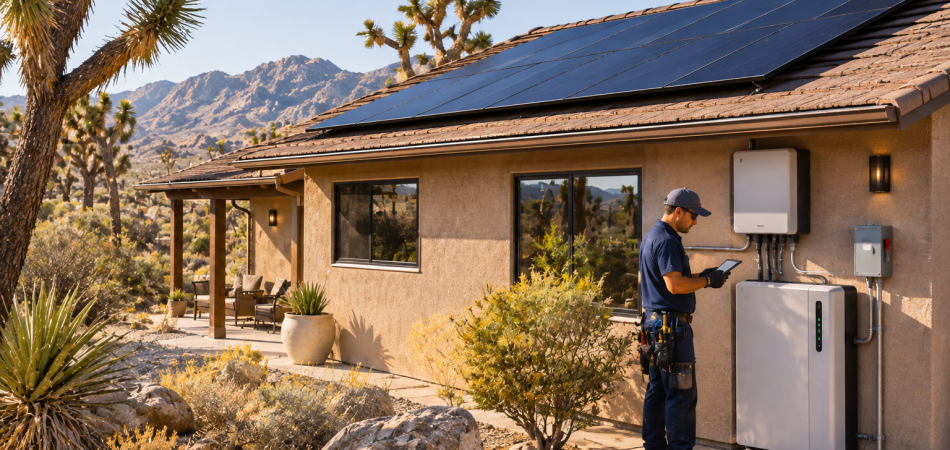
Homeowners in Twentynine Palms, Joshua Tree, and Yucca Valley may benefit from solar systems designed around air conditioning demands and actual household electricity usage.
-
Battery storage can increase the amount of solar energy used at home during expensive evening hours, but it also adds to installation costs.
-
The most useful solar estimates account for the roof, electrical panel, future energy needs, and projected utility bill savings rather than focusing exclusively on panel production.
Is Solar Still a Good Investment for High Desert Homeowners in 2026?
Solar can remain a worthwhile investment for High Desert homeowners in 2026 when the system is appropriately sized, installation costs are reasonable, and the household can use a meaningful portion of its solar production. However, homeowners should evaluate projected savings under current California net billing rules rather than relying on financial assumptions from several years ago.
Twentynine Palms and the surrounding Morongo Basin receive abundant sunshine, creating opportunities for residential solar production throughout the year. At the same time, intense summer temperatures can place substantial demands on air conditioning systems, increasing household electricity consumption.
For homeowners in Joshua Tree, Yucca Valley, Wonder Valley, and Landers, the relationship between solar production and electricity usage is especially important. A household that uses significant electricity while the panels are producing power may experience different financial results than one that consumes most of its electricity after sunset.
At Wonder Electric Co, Inc., we’ve served the High Desert since 1974 as a family-owned electrical contractor based in Twentynine Palms. Our experience with residential electrical systems, solar installations, and the region’s demanding climate helps us evaluate the entire property rather than focusing on solar panels alone.
We consider how existing electrical equipment, future energy needs, and appropriate system design fit together. That approach helps homeowners understand whether a proposed solar installation supports their practical and financial goals.
How California’s Net Billing Rules Affect Solar Savings in 2026
California’s Net Billing Tariff changes the financial value of residential solar by compensating homeowners for exported electricity based on its value to the grid rather than providing the older retail-rate-style credits. For most new Southern California Edison solar customers, this makes the timing of electricity production and consumption especially important.
The California Public Utilities Commission introduced the current Net Billing Tariff for applicable new interconnection applications beginning April 15, 2023. SCE refers to its version of the program as the Solar Billing Plan.
How Does the Solar Billing Plan Work?
Under SCE’s Solar Billing Plan, your solar system supplies electricity to your home first. When your panels generate more electricity than you’re using, the excess power can flow to the electric grid, where it earns Energy Export Credits.
The value of those credits varies according to when the electricity is exported. During periods when solar production is plentiful, especially around midday, export compensation is generally lower than the retail electricity rate.
SCE’s published 2026 average export values illustrate the difference:
-
Summer daytime exports, from 6 a.m. to 4 p.m., average approximately 6 cents per kilowatt-hour.
-
Summer evening exports, from 4 p.m. to 9 p.m., average approximately 21 cents per kilowatt-hour.
-
Winter daytime exports average approximately 3 cents per kilowatt-hour.
These are published averages rather than guaranteed compensation for every hour. Actual credits vary, and eligible customers may also receive additional export bonus credits under applicable program rules.
Why Using Your Own Solar Electricity Matters
Imagine your home in Twentynine Palms generates substantial electricity around noon, but most of your household’s energy consumption occurs after sunset. Under the Solar Billing Plan, exporting that midday production and purchasing electricity later may be less financially beneficial than using the generated power directly.
This is why solar system design should consider when you use electricity, not simply how much you consume annually.
Homeowners who operate air conditioning, pool equipment, or other significant electrical loads during sunny hours may be able to use more solar production directly. However, individual savings still depend on SCE’s applicable rates, actual usage, and the system’s performance.
How Much Does Residential Solar Cost in California in 2026?
Residential solar installation costs in California in 2026 depend on system size, equipment selection, roof conditions, electrical improvements, and whether battery storage is included. For homeowners in the Morongo Basin, obtaining a property-specific estimate is more reliable than assuming a statewide average represents the actual cost of the project.
A smaller system serving a relatively efficient home may require less equipment than one designed for a property with extensive cooling demands, an EV charger, or a detached workshop.
What Affects the Cost of a Solar Installation?
Several factors influence the total project price:
-
System size: The number and capacity of panels needed to meet appropriate energy production goals.
-
Roof conditions: Available space, orientation, shading, structural condition, and mounting requirements.
-
Electrical panel capacity: Whether the existing electrical equipment can accommodate the proposed installation.
-
Battery storage: The number and capacity of batteries, along with additional equipment and installation requirements.
-
Site configuration: Distance between equipment locations, accessibility, and existing electrical infrastructure.
-
Permitting and interconnection: Required approvals, inspections, and utility coordination.
For example, an older home in Joshua Tree may need an electrical panel evaluation before solar can be installed. A newer property in Yucca Valley with a suitable roof and modern electrical equipment may have different installation requirements.
Homeowners should request itemized estimates that separate solar equipment, storage, electrical upgrades, and other major project components. This makes it easier to understand what the proposed installation includes and how different system configurations affect the overall investment.
What Happened to the Federal Solar Tax Credit?
The federal Residential Clean Energy Credit previously allowed qualifying homeowners to claim a tax credit equal to 30% of eligible residential solar and battery storage costs.
However, federal legislation enacted in July 2025 ended the credit for expenditures made after December 31, 2025. The IRS confirms that installations completed after that deadline do not qualify for the former Section 25D credit, even if the homeowner made payments before the end of 2025.
Consequently, homeowners planning residential solar installation in 2026 should not subtract the former 30% federal tax credit from their projected project costs.
Other incentives or financing programs may be available depending on eligibility, but these should be verified before being included in a financial estimate.
Is Solar Battery Installation Worth the Additional Cost?
Solar battery installation can improve the value of residential solar under California’s current net billing rules by storing excess daytime electricity for use during more expensive evening hours. However, batteries increase upfront costs, and whether the investment makes sense depends on household consumption, storage capacity, equipment pricing, and backup power priorities.
For homeowners in the Morongo Basin, battery storage can be particularly appealing when air conditioning and other household loads continue after sunset.
Solar-Only Versus Solar-Plus-Battery Systems
A solar-only system can be a practical option for homeowners who use substantial electricity during daylight hours. When the panels generate electricity, the household consumes that power directly, reducing the amount purchased from the utility.
A solar-plus-battery system offers additional flexibility. Instead of exporting all unused daytime production, the battery can store some of that electricity for later use.
Under SCE’s Solar Billing Plan, this can help reduce purchases of higher-priced electricity during evening periods. The utility specifically identifies battery storage as a way to increase the value of solar energy consumed at home.
Can Solar Batteries Keep Your Home Running During an Outage?
Some battery systems can supply electricity during a utility outage, but backup capabilities depend on the equipment and installation design. A battery intended primarily for bill savings doesn’t necessarily provide whole-home emergency power.
For example, a properly configured backup system might support selected circuits serving refrigeration, lighting, communications equipment, or other essential loads. Operating a large central air conditioning system may require substantially more battery capacity.
Before purchasing storage equipment, homeowners should discuss which appliances they want powered during an outage and how long that backup is expected to last. These considerations can affect the battery’s size, installation requirements, and total project cost.
Are There California Solar and Battery Incentives Available in 2026?
California homeowners may still qualify for certain solar and battery incentives in 2026, although eligibility varies by program, household circumstances, and available funding. The expiration of the federal Residential Clean Energy Credit doesn’t mean every state-administered incentive has disappeared.
One program worth investigating is California’s Self-Generation Incentive Program (SGIP), which supports eligible distributed energy systems.
The California Public Utilities Commission administers SGIP, including residential solar and storage equity incentives for qualifying low-income households. Eligibility requirements, funding availability, reservation procedures, and program conditions should be confirmed before homeowners assume an incentive will apply.
For homeowners in Twentynine Palms and neighboring communities, checking current program requirements can be worthwhile when comparing battery storage options.
However, an incentive should only be included in a projected savings calculation when eligibility and availability have been reasonably established.
How to Calculate Long-Term Solar Savings for Your High Desert Home
Long-term solar savings depend on comparing the complete installation investment with realistic projections of avoided utility purchases, export credits, ongoing expenses, and future electricity usage. A useful financial evaluation should reflect SCE’s current billing structure rather than assuming every kilowatt-hour produced receives the same value.
For homeowners in Twentynine Palms, the most important starting point is reviewing actual electricity consumption throughout the year.
What Should a Solar Savings Estimate Include?
A detailed residential solar evaluation should account for:
-
Annual electricity usage: Review a full year of utility bills to understand seasonal consumption.
-
Time-of-use patterns: Determine how much electricity is consumed during sunny daytime hours versus evenings.
-
Projected solar production: Evaluate expected output based on roof orientation, shading, and system size.
-
Export compensation: Apply appropriate SCE Solar Billing Plan values instead of assuming retail-rate credits.
-
Battery storage: Compare the additional investment with potential savings and backup benefits.
-
Electrical upgrades: Include necessary panel improvements and related installation costs.
-
Ongoing expenses: Consider maintenance, future equipment replacement, and applicable financing costs.
-
Future household changes: Account for planned EV charging, electric appliances, workshops, or other additional loads.
For example, a homeowner in Yucca Valley who plans to purchase an electric vehicle may eventually consume more electricity than historical utility bills indicate. A system evaluation should consider those plans rather than relying exclusively on current consumption.
SCE also has requirements related to sizing solar systems around expected household electricity demand. Homeowners planning additional electrical loads should discuss how those changes affect proposed system capacity and interconnection documentation.
How Long Does It Take for Solar to Pay for Itself?
Solar payback is the time needed for accumulated financial benefits to offset the system’s net investment. There isn’t a reliable universal payback period for California homeowners in 2026 because costs, electricity consumption, export compensation, and financing arrangements vary considerably.
A cash purchase and a financed installation may also produce different financial results. Loan interest, fees, and repayment terms can affect the total cost of ownership even when the equipment is identical.
Rather than relying on a promised payback date, homeowners should request a clear projection showing the assumptions used. Comparing several realistic scenarios can reveal whether the potential long-term savings justify the investment.
When Solar Might Not Be the Right Investment
Solar may be less financially attractive when installation costs are high, the property has significant shading, the roof needs substantial work, or the household uses relatively little electricity. These conditions don’t automatically rule out solar, but they can affect the potential return.
Older homes throughout Joshua Tree, Landers, and Wonder Valley may also require electrical improvements before new solar equipment can be installed. A panel upgrade or other necessary work adds to the investment and should be considered from the beginning.
Homeowners expecting to move soon should evaluate whether they will remain in the property long enough to benefit from projected electricity savings. Any potential resale value should be treated as uncertain rather than guaranteed.
In some situations, improving insulation, sealing air leaks, or upgrading inefficient cooling equipment may be worth considering before finalizing a solar system size. Reducing unnecessary electricity consumption can change how much solar capacity the home actually needs.
Frequently Asked Questions About Solar in California in 2026
1. Is solar worth it in California in 2026 without the federal tax credit?
Solar can still be financially worthwhile without the former federal tax credit, particularly for homeowners who consume substantial electricity during solar production hours. However, the upfront investment is higher without that incentive. Projected savings should reflect current utility rates, installation costs, and the household’s actual electricity consumption.
2. How does California net billing work for Twentynine Palms homeowners?
Most new residential solar customers served by Southern California Edison participate in the Solar Billing Plan. Solar electricity used directly in the home offsets eligible grid purchases, while excess electricity exported to the grid earns time-dependent credits. Those credits generally differ from the retail electricity rates customers pay.
3. Does solar battery storage make sense in the Morongo Basin?
Battery storage can make sense when homeowners want to use more daytime solar production during expensive evening hours or value appropriately configured backup power. However, battery equipment increases installation costs. The financial benefits depend on storage capacity, household electricity patterns, SCE rates, and available incentives.
4. Can I still get a 30% federal solar tax credit in 2026?
No, the former federal Residential Clean Energy Credit is unavailable for new residential solar or battery installations completed after December 31, 2025. The IRS confirms that the previous Section 25D credit ended for expenditures made after that date. Homeowners should not include it in 2026 installation estimates.
5. Do older homes in Joshua Tree or Yucca Valley need electrical upgrades before solar?
Some older homes need electrical improvements before a solar installation, but not every property requires a panel replacement. An electrician should evaluate the existing equipment, electrical capacity, and proposed solar configuration. Necessary upgrades depend on the condition of the system and the installation’s specific requirements.
6. Will solar panels eliminate my Southern California Edison bill?
Solar panels may reduce electricity charges substantially, but they don’t guarantee a zero-dollar utility bill. SCE’s Solar Billing Plan includes charges that cannot be eliminated through energy export credits. Actual costs also depend on electricity purchases, system performance, rate schedules, and applicable fees.
7. Can solar and battery storage power my air conditioner during an outage?
Some appropriately designed battery backup systems can operate air conditioning equipment during an outage, but available capacity varies significantly. Larger cooling systems may require additional batteries or specialized equipment. Homeowners should identify their intended backup loads before selecting a battery configuration.
8. How can I tell whether my Twentynine Palms home is suitable for solar?
Start with a professional evaluation of your roof, electrical panel, household consumption, and future energy plans. A qualified solar energy contractor can review expected production, installation requirements, and current utility billing considerations. This information helps determine whether solar-only or solar-plus-battery equipment is appropriate.
Make Your Solar Investment Work for Your High Desert Home
Solar remains an option worth exploring for California homeowners in 2026, but understanding the financial details is more important than ever. With the former federal residential tax credit no longer available and SCE’s Solar Billing Plan placing greater emphasis on when electricity is used, homeowners need realistic expectations about costs, export credits, and potential savings. For properties throughout Twentynine Palms, Joshua Tree, Yucca Valley, and the surrounding Morongo Basin, a well-planned system can still offer meaningful benefits when it matches the home’s energy needs and financial goals.
At Wonder Electric Co, Inc., we’ve been serving High Desert property owners since 1974, providing professional electrical and solar services backed by decades of local experience. As a family-owned, licensed, and insured electrical contracting company, we understand the importance of evaluating the entire home before recommending a solar installation. From electrical panel assessments and upgrades to residential solar installation and battery storage planning, our team helps homeowners explore practical solutions suited to their properties. We offer free project estimates for solar and related electrical work, making it easier to understand your options before moving forward.
Find Out Whether Solar Makes Sense for Your Twentynine Palms Home
Your solar investment should reflect your household’s electricity needs, existing electrical system, and long-term financial goals. Contact Wonder Electric Co, Inc. to discuss your project and schedule a professional solar evaluation for your High Desert property.